Surface
Smooth gravel can flow; sand, mud, rocks, gates, and hike-a-bike can collapse average speed.
Bikepacking distance per day
A useful daily target starts with surface and intention, then yields to climbing, daylight, weather, resupply, sleep, and how your loaded bike actually moves. Use a range to sketch the trip—not to bully every day into the same number.
The answer in one minute
For a first draft, many riders can explore a lower band on rough terrain and a higher band on pavement or smooth gravel. The calculator above deliberately gives a wide range because “60 km” can mean an easy rail trail or a day of pushing a loaded bike.
A 54.3 km worked example
The production bicycle router estimates 54.3 km and about 3h 18m of moving time. That is not the whole day. A rider still needs to account for the loaded bike, stops, weather, route verification, and the value of finishing in a town with services.
Bikepacking Live lets you store the realistic stage rather than a universal mileage goal. Sign up to save the trip, then adjust each day independently as the itinerary becomes real.
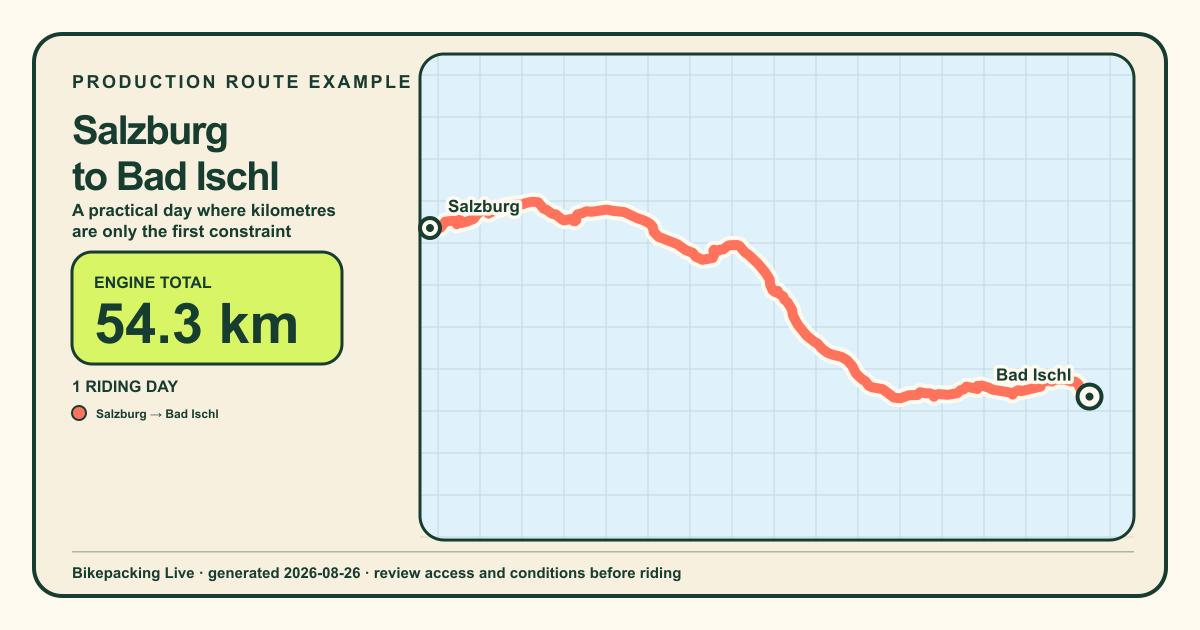 GENERATED 2026-08-26
Generated with the same production bicycle router used by Bikepacking Live. Always verify current access, surfaces, closures, weather, and local conditions before riding.
Six reasons tomorrow is not today
Smooth gravel can flow; sand, mud, rocks, gates, and hike-a-bike can collapse average speed.
Total ascent matters, but steepness and whether the climb is rideable matter too.
A summer day and an autumn shoulder-season day do not offer the same safe margin.
Camping gear, food, and water alter acceleration, handling, comfort, and the cost of every climb.
A fixed train, ferry, campsite check-in, or resupply window can be the real limit.
The question is not whether you can finish one hard day, but what legs it leaves for the next one.
Daily-distance questions
It can be relaxed, demanding, or impossible depending on surface, ascent, weather, daylight, and the rider. Judge the specific route and consecutive-day context.
No. Make hard terrain shorter, protect fixed logistics, and let useful overnight places create intentionally uneven days.
No. It is a discussion starter, not a performance model. Inspect the real route and reduce the range when climbing or technical terrain increases the effort.
The account saves the trip and its different daily stages so your revised plan is not trapped in one browser session.
Turn the range into a trip
Create a free account, save the route as realistic stages, and revise every day without publishing it.